

A Look at the Phases of New Construction Plumbing — From the First Trench to the Final Trim
Nobody is impressed by the pipes. That's fine. That's kind of the point.
When someone walks into a finished home for the first time — new floors, fresh paint, fixtures gleaming under the light — they're not thinking about what's buried under the slab. They're thinking about where the couch is going. The plumbing is invisible, and if everything was done right, it should stay that way.
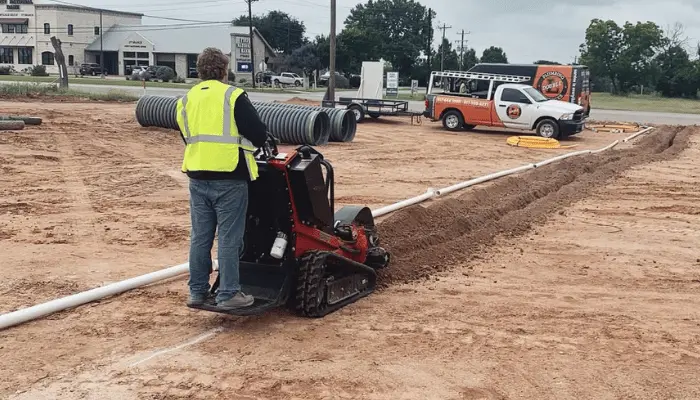
That photo above is from a job site right here in North Texas. One of our guys is running a trencher through that distinctive red clay, cutting a path for PVC pipe that will eventually carry water and waste for a building that, at that moment, doesn't even have walls. It's not glamorous work. It's also the most important work on that site — because what gets buried here sets the terms for everything that comes after.
Here's what new construction plumbing actually involves, from that first trench to the day someone turns on a faucet for the very first time.
Why Plumbing Can't Wait
New construction plumbing isn't a finish trade. It's not something you bring in near the end, like paint or trim work. It has to be thought through before the first shovel hits the ground — because the layout of every bathroom, kitchen, utility room, and mechanical space flows from where the plumbing can realistically run.
Where does the main water service come in from the street? Where does the sewer connect? Where does the gas meter land, and how far does the line have to run to reach the range, the water heater, the outdoor kitchen? These decisions shape floor plans. A plumbing contractor who's involved early helps you avoid the situation where someone has to move a bathroom three feet because the drain can't get to where it needs to go once the framing is up.
If you're planning a build and want a head start on the decisions that matter most upfront, we put some of the key ones together in this post.
Phase One: Underground Rough-In
This is the work nobody talks about.
Before a slab is poured, the crew comes in and lays all the underground pipe — the drain lines, the waste lines, the supply lines that will eventually branch up into the finished building. Every stub-out for every toilet, every floor drain, every floor-mounted fixture has to be in exactly the right place. Once the concrete goes down, there's no moving it without cutting through the slab.
In North Texas, this phase is harder than it looks. Parker and Tarrant County are built on expansive clay — the kind that swells when it rains and contracts when it doesn't, which in a Texas summer means the ground is slowly and constantly moving beneath your feet. Pipe has to be bedded correctly so that movement doesn't translate into joint stress over the next several decades. The plumbers who've been doing this work long enough know how to read the soil and where to add bedding, because they've seen what happens when it's done wrong.
This is also when the sewer connection is made — either to the city main or to a septic system, depending on location. The two are completely different scopes of work with different permitting requirements. Our sewer services cover both, and we pull the appropriate permits for every job.
Underground rough-in is inspected by the city before the slab can be poured. It has to pass. Once the concrete goes down, those pipes are gone — and accessing them means cutting through your foundation. Getting it right the first time isn't optional here; it's the whole job.
Phase Two: Above-Ground Rough-In
Once the slab is down and the framing goes up, the plumbers come back.
This is where the layout of every fixture in the building gets established in three dimensions. Supply lines branch out through walls and floors to every sink, toilet, shower, bathtub, laundry connection, refrigerator water line, dishwasher, and outdoor hose bib. Drain lines are run at precise slopes — too flat and waste won't flow properly; too steep and liquid outruns the solids and leaves buildup behind. Vent lines are run up through the roof to keep the entire drain system breathing with the right air pressure.
If the build includes gas appliances — a range, a dryer, a tankless water heater, a gas fireplace, an outdoor kitchen — the gas lines get run during this phase as well. Gas work requires its own permits and inspection, and it has to be coordinated tightly with the HVAC and electrical crews who are working in the same walls at the same time. A plumber who doesn't show up when they're supposed to doesn't just fall behind on their own work — they create a domino effect for every other trade on the project.
Above-ground rough-in passes a second inspection before the walls close. Once drywall goes on, what's inside is sealed in. Finding a problem at that point means opening walls — which is exactly as expensive and disruptive as it sounds.
Phase Three: Top-Out
Top-out is the point where everything gets tested.
Vent pipes are extended through the roof, and the entire drain-waste-vent system is pressurized with air. Every joint and fitting is checked. If there's a leak anywhere in the system, you find it here — not two years from now when someone starts smelling sewer gas in the hallway.
This phase also includes setting fixtures that have to go in before the walls are finished around them — shower pans, walk-in tub surrounds, built-in tub units. The sequencing with tile setters and finish carpenters has to be precise. A plumber who has to redo work because a wall went up in the wrong order is now behind on every other job they have.
For commercial builds, top-out involves more complexity: floor drains, grease traps, backflow preventers, commercial-grade fixtures with specific clearance requirements. Our commercial plumbing team works regularly on restaurants, office buildings, retail spaces, and multi-family properties — projects where the code requirements, inspection process, and fixture specifications differ significantly from residential work.
Phase Four: Trim-Out
Trim-out is what people see.
This is the final phase — installing and connecting every fixture with a visible face: faucets, toilets, shower valves and trim kits, tub spouts, supply stops, drain covers, escutcheons. Everything that will be looked at and touched every day for the next several decades goes in now. Our team handles plumbing fixture installation for a wide range of fixture types and brands, and we'll tell you honestly when a builder-grade fixture isn't going to hold up the way a homeowner expects it to.
This is also when the water heater goes in. Whether the project calls for a traditional tank unit or a tankless system, it gets connected to supply lines and gas or electrical service and commissioned. Tankless units require careful sizing relative to the number of fixtures and expected simultaneous demand — an undersized unit is one of the most common complaints in new construction, and it's entirely avoidable with the right conversation before the unit is ever ordered.
The water service line from the meter to the building is finalized, the meter is set, and the system is charged with water and pressure-tested one final time. A walk-through inspection closes the loop before the certificate of occupancy is issued.
Trim-out is where the care from the previous three phases either shows or doesn't. Fixtures should be level. Drain covers should sit flush. Supply stops should turn. The homeowner or building owner is seeing this work for the first time — and what they see reflects on the plumber and everyone else who built the project.
What to Look for When You're Choosing a New Construction Plumber
New construction is a different discipline than service and repair. The skills overlap, but the work doesn't. Here's what actually matters:
- Licensure. New construction plumbing is inspected by the city at multiple stages. Your plumber needs to be licensed to pull permits and stand behind those inspections. The license isn't a formality — it's what gives them the legal authority to do the work.
- The right experience for your project type. Residential and commercial new construction have different code requirements, different inspection processes, and different fixture specifications. Ask whether a plumber has done your type of build before, and ask for references from general contractors they've worked with.
- Scheduling discipline. A plumber who doesn't coordinate with other trades and show up on time doesn't just fall behind on their own work — they create delays for every subcontractor scheduled after them. Ask any GC about their worst job site experiences and scheduling will come up.
- Straight answers on materials and options. Pipe material, water heater type and sizing, fixture grades, gas line capacity — there are real decisions to make in new construction, and they have real long-term consequences. A plumber who tells you what's easiest for them isn't serving your interests.
- Transparency on the job. For builders and general contractors, visibility into where a project stands matters as much as the work itself. Double L uses Buildertrend, so you can follow your project in real time, submit plans, review invoices, and track progress without chasing anyone down. That kind of coordination is what keeps a build on schedule.
Double L Plumbing is owned by a Master Plumber — the highest license level in the trade in Texas. That standard carries through every job our team takes on. We pull our own permits, handle our own inspections, coordinate directly with general contractors and other trades, and show up when we say we will. We've built our reputation in this area one job at a time — including the jobs nobody ever sees, buried three feet down in the red clay before the slab was poured.
Building in Azle, Weatherford, or the Surrounding Area? Let's Talk.
Whether you're a homeowner breaking ground on a custom build, a general contractor looking for a dependable plumbing sub, or a developer starting a commercial project — Double L handles new construction plumbing from the first trench to the final trim.
We work throughout Azle, Weatherford, Springtown, Fort Worth, and the surrounding North Texas area. Give us a call and we'll give you a straight answer on scope, timeline, and cost. Give us a call at 817-444-3100 .
That's how we work on every job — including yours.